
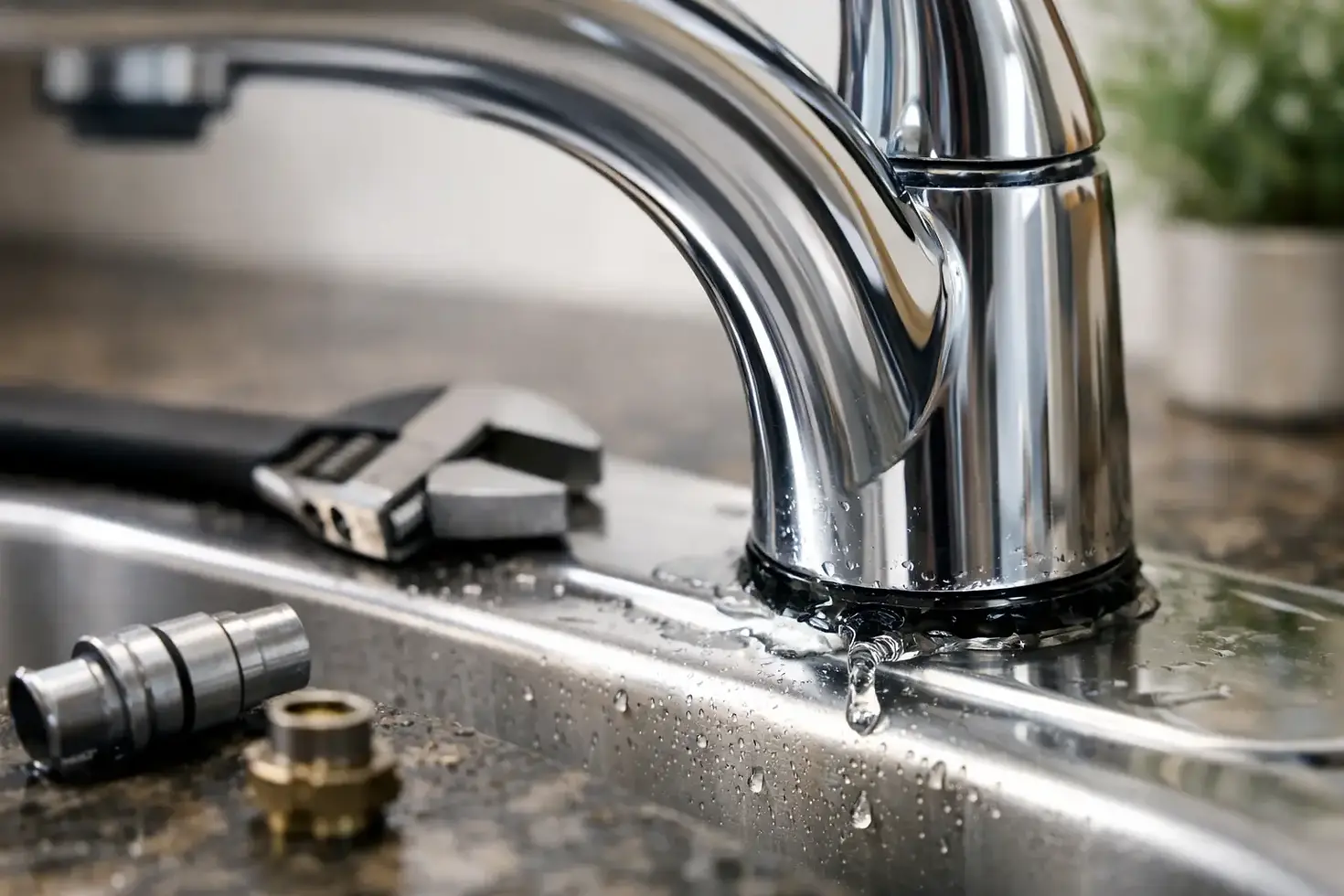
Faucet Leaking From Base: Causes and Fixes
Water collecting around the sink is more than an annoyance. A faucet leaking from base can soak the countertop, damage the cabinet below, and leave moisture where mold can develop. In South Florida, where humidity already puts pressure on kitchens and bathrooms, even a small fixture leak deserves prompt attention.
The good news is that a leak at the bottom of a faucet is often repairable. The right fix depends on when the water appears, the faucet style, and whether the water is truly coming from the faucet base or from plumbing connections under the sink.
Why Is Your Faucet Leaking From the Base?
The base is the point where the faucet body meets the sink or countertop. In most cases, water reaches this area because internal seals have worn down. When you turn on the faucet, water moves through the spout and valve body. If an O-ring, cartridge seal, or gasket no longer fits tightly, water can escape inside the faucet and run down to the base.
A faucet may also leak from the base because the faucet body is loose. A loose mounting nut can create a gap at the sink surface, allowing splashed water or an internal leak to work underneath the fixture. This is common with older kitchen faucets, heavily used bathroom faucets, and fixtures installed on thin or damaged countertops.
The timing of the leak provides a useful clue. If water appears only while the faucet is running, the problem is usually inside the faucet assembly. If the water appears even when the faucet is off, check the supply lines, shutoff valves, drain connections, and nearby plumbing under the sink. Water can travel along a hose or faucet body before it becomes visible at the base.
Common Causes of a Faucet Base Leak
Worn O-rings and seals
Many single-handle faucets use O-rings to seal moving parts inside the body. These rubber rings wear with age, mineral buildup, frequent use, and normal friction from operating the handle. Once an O-ring becomes brittle, flattened, or cracked, water can bypass it and pool around the faucet base.
A worn gasket under the faucet can also allow water to slip below the fixture. This is especially likely if the sink is frequently wet around the faucet or if the fixture has shifted over time.
A failing cartridge or valve assembly
In a single-handle faucet, the cartridge controls water flow and temperature. A damaged cartridge can leak internally even if the handle still feels normal. Depending on the model, replacing the cartridge may stop the leak, but it is important to use the correct part. Cartridges are not universal, and specialty replacement parts can be difficult to identify on older fixtures.
Two-handle faucets may instead have worn stems, seats, washers, or packing nuts. The repair approach differs by manufacturer and faucet type, which is why taking apart a fixture without the right replacement parts can turn a small repair into a longer interruption.
Mineral buildup and corrosion
Hard-water minerals can collect inside the faucet, restricting movement and damaging seals. Corrosion may also affect the valve body, mounting hardware, or supply connections. A faucet that has been in place for many years may have more than one issue, such as a failing cartridge and a corroded mounting nut.
Corrosion is not always visible from above. A professional inspection can determine whether the faucet can be rebuilt or whether replacement is the more dependable choice.
Loose mounting hardware
A faucet should sit firmly against the sink or countertop. If it rocks when you move the spout or handle, the mounting hardware below may be loose. Tightening the faucet can sometimes correct the problem, but it will not repair an internal leak. If water is coming through the faucet body, new seals or a cartridge may still be needed.
A leak under the sink that looks like a base leak
Before assuming the faucet itself is the problem, dry the area completely and inspect underneath the sink with a flashlight. Look for moisture at the hot and cold supply lines, shutoff valves, pull-out spray hose, and drain piping. Run the faucet slowly, then at full flow, while watching for drips.
If water appears beneath the cabinet only while the faucet runs, a damaged hose or loose connection may be the source. If the cabinet is wet when no one has used the sink, shut off the water supply to that fixture and arrange service promptly.
Safe Checks Before You Start a Repair
A homeowner can often narrow down the cause without disassembling the faucet. First, wipe the faucet, sink deck, and cabinet dry. Place a dry paper towel around the base, then turn on the water and observe where the moisture begins. Repeat with both hot and cold water if the faucet has separate handles.
Next, check whether the faucet moves. A slight amount of rotation may be normal on certain kitchen faucets with a swivel spout, but the entire fixture should not wobble at the sink deck. Then inspect under the sink for drips at the supply lines and connections.
If you decide to remove a handle or replace a cartridge, shut off both fixture shutoff valves first. Open the faucet to release remaining pressure, plug the drain so small screws cannot fall into it, and protect the sink surface with a towel. Take clear photos as you work so parts can be reassembled in the proper order.
Do not force a stuck handle, retaining nut, or cartridge. Florida humidity, mineral buildup, and corrosion can seize parts in place. Excess force can crack the faucet body, damage a countertop, or break a supply connection. That is the point where professional service is usually the safer and less costly option.
When a Repair Makes Sense and When Replacement Is Better
Replacing an O-ring, washer, or cartridge is often worthwhile when the faucet is in good overall condition and replacement parts are available. This is especially true for a quality fixture that matches the other finishes in the room.
Replacement may make more sense when the faucet is badly corroded, the finish is peeling, parts are discontinued, or multiple components are failing. A newer faucet can also be a practical choice when a property owner wants improved water efficiency, a pull-down kitchen sprayer, touchless operation, or a finish that better suits a renovation.
The trade-off is not simply the cost of a new fixture. Installation conditions matter. Older shutoff valves, deteriorated supply lines, tight cabinet spaces, and damaged sink openings can add work to what appears to be a straightforward replacement. A trained plumber can assess the complete setup, recommend the right path, and test the fixture before leaving.
When to Call a Plumber for a Leaking Faucet Base
Call for professional help when the leak is causing cabinet damage, water is reaching electrical outlets or appliances, the shutoff valves do not work, or the faucet cannot be taken apart without force. Service is also advisable when you see corrosion, have a specialty or older fixture, or cannot identify the correct replacement cartridge.
For property managers and commercial building owners, a small fixture leak should be addressed before it becomes a tenant complaint, cabinet replacement, or mold remediation issue. Consistent repair documentation and reliable parts sourcing are particularly valuable where multiple units use similar fixtures.
South Shore Plumbing has served Palm Beach, Broward, and North Miami-Dade Counties since 1986. Our trained technicians can identify whether a faucet needs a seal repair, cartridge replacement, fixture replacement, or a closer inspection of the plumbing beneath the sink. We work carefully in occupied homes and buildings, explain the issue clearly, and test the repair before the job is complete.
A dry paper towel at the faucet base today can save a cabinet, countertop, or flooring repair tomorrow. If the source is not obvious or the leak continues after a basic check, have the fixture inspected and repaired correctly the first time.


Comments